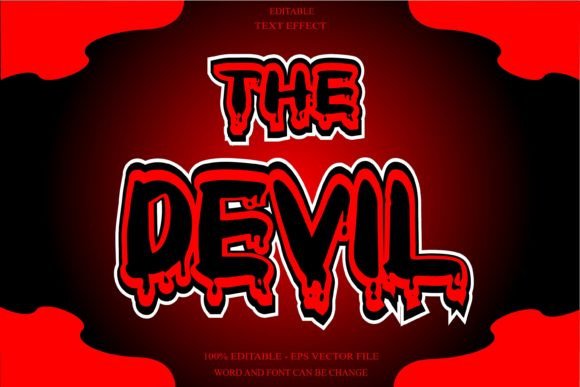
Unleashing Dark Typography: A Practical Guide to The Devil Editable Text Effect
There is a distinct moment in graphic design when standard typography simply fails to convey the weight of a message. You need something that feels dangerous, ancient, or unsettlingly organic. This is where The Devil Editable Text Effect steps in, not merely as a font, but as a transformative tool for Adobe Illustrator users who demand more than static lettering. It is crucial to understand from the outset that this is not a traditional typeface you install into your system folder. Instead, it is a sophisticated vector effect designed specifically for Adobe Illustrator, offering a level of control and scalability that raster images or basic fonts cannot match.
For designers working within the constraints of tight deadlines but high creative expectations, the appeal lies in its adaptability. Because it operates entirely within the Illustrator ecosystem, it integrates seamlessly into existing workflows. Whether you are crafting a heavy metal album cover, designing packaging for a bold new energy drink, or creating atmospheric assets for a horror-themed video game, this effect provides an immediate visual hook. The ability to apply this jagged, intense aesthetic to any font or shape means you are not locked into a single typographic style. You retain full creative ownership over the underlying structure while the effect handles the complex texturing and distortion.
Real-World Applications Across Industries
The versatility of The Devil Editable Text Effect becomes apparent when we look beyond generic "scary" designs. Its utility spans several professional industries where impact and memorability are paramount. Consider the music industry, particularly within genres like metal, punk, or dark electronic music. Band logos and tour posters require a visual identity that screams rebellion and intensity. Using this effect, a designer can take a clean, modern sans-serif font and instantly corrupt it with demonic textures, creating a logo that feels both contemporary and timeless. The EPS file format ensures that whether the logo is printed on a small guitar pick or a massive stage banner, the edges remain crisp and the details sharp.
In the realm of entertainment and gaming, asset creation often requires rapid prototyping. Game developers and UI designers frequently need title screens or in-game signage that conveys danger or mystery. With this tool, they can generate unique title treatments without needing to commission custom hand-lettering for every iteration. The fact that it is 100% editable means that if a client decides the title needs to be longer, shorter, or in a completely different typeface, the adjustment takes seconds rather than hours. This efficiency is invaluable in agile development environments where changes are frequent and time is scarce.
Marketing and advertising also benefit significantly from such bold visual tools. Imagine a promotional campaign for a Halloween event, a thriller novel launch, or a limited-edition product with a "dark side" theme. Standard fonts often feel too safe or corporate for these campaigns. By applying The Devil Editable Text Effect, marketers can create eye-catching social media graphics and print ads that stop the scroll. The psychological impact of distorted, aggressive typography captures attention quickly, making it an effective tool for cutting through the noise of saturated digital feeds.
Why Editability Matters More Than You Think
One of the most common frustrations designers face with specialized text effects is the lack of flexibility. Many downloadable assets come as flattened PNGs or rigid PSD files where changing the text requires rebuilding the entire layer structure. This is where the architecture of The Devil Editable Text Effect shines. Because it is built for Illustrator, it leverages the power of vector graphics. You are not just editing pixels; you are manipulating mathematical paths. This means you can scale the text to the size of a billboard without losing a single detail, or shrink it down for a business card while maintaining clarity.
The workflow is surprisingly intuitive for anyone familiar with Adobe Illustrator. You do not need to be a scripting expert or a veteran illustrator to make it work. The process typically involves typing your desired text, selecting a base font that suits your mood, and then applying the effect. From there, the customization options are extensive. You can adjust the severity of the distortion, the thickness of the lines, and the overall density of the texture. This level of granular control allows for a wide range of interpretations. One designer might use it to create subtle, eerie whispers in a background texture, while another might push it to the extreme for a loud, aggressive headline.
Furthermore, the compatibility with any font or shape opens up creative possibilities that go beyond text. You can apply the effect to simple geometric shapes, icons, or even custom-drawn illustrations. This makes it a versatile asset for creating cohesive brand elements. For instance, a brand could have a logo mark that uses the same demonic texture as their typography, creating a unified visual language. This consistency is key to strong branding, and having a single tool that can apply the same aesthetic across different types of vector objects simplifies the design process immensely.
Technical Considerations and Best Practices
Before integrating The Devil Editable Text Effect into your next project, it is important to consider the technical environment. Since this is an Adobe Illustrator-specific effect, it cannot be opened or edited in other software like Photoshop, CorelDRAW, or Affinity Designer without first expanding the appearance. If your workflow involves multiple programs, you should plan your stages accordingly. Keep the editable Illustrator file as your master source, and only export to other formats once the design is finalized. This preserves the ability to make last-minute tweaks without starting over.
Another consideration is the complexity of the base font. While the effect works with every font, the results vary significantly depending on the weight and structure of the typeface chosen. Thin, delicate scripts may get lost in the distortion, while heavy, bold block letters tend to hold the effect best. Experimentation is key here. Designers should test a variety of fonts to see how the effect interacts with different letterforms. Serif fonts might produce a more gothic, Victorian horror vibe, while geometric sans-serifs could create a modern, industrial dystopian look. Understanding these nuances allows for more intentional design choices.
It is also worth noting that while the effect is easy to use, it should not be overused. Like any powerful design element, it loses its impact if applied to every piece of text on a page. Use it strategically for headlines, logos, or key focal points. Pair it with clean, readable body text to create contrast and ensure legibility. This balance between chaos and order is what makes professional design effective. The goal is to enhance the message, not obscure it.
Maximizing Value for Creative Professionals
For freelance designers and agency teams, investing in tools like The Devil Editable Text Effect is about more than just aesthetics; it is about efficiency and client satisfaction. Clients often struggle to articulate exactly what they want, using vague terms like "edgy" or "intense." Having a tool that can instantly visualize these concepts helps bridge the communication gap. You can present multiple variations quickly, allowing the client to choose the direction that resonates most with their vision. This iterative process builds trust and demonstrates professionalism.
Moreover, the scalability of the EPS format ensures that your work is future-proof. As brands evolve, their assets need to adapt to new mediums, from mobile apps to large-format outdoor advertising. Knowing that your text effect will render perfectly at any size gives you confidence in your deliverables. It eliminates the need for recreating assets for different resolutions, saving time and reducing the risk of errors.
Ultimately, The Devil Editable Text Effect is a testament to the power of specialized tools in modern graphic design. It solves a specific problem—creating high-impact, dark typography—with elegance and efficiency. By understanding its capabilities, limitations, and best use cases, designers can unlock new levels of creativity and productivity. Whether you are a seasoned professional or an enthusiastic amateur, this tool offers a straightforward path to achieving complex, professional-grade results without the steep learning curve associated with manual illustration techniques.